When we visit a series of islands, we stay one day where there is little interest (like Filicudi and Alicudi) and two days in others (like Salina).
At the end of this visit, we pick one island that we think is worth a closer look and a longer stay. This trip we chose to revisit Lipari, probably rent a scooter and spend two days exploring it. From Alicudi, it’s approximately a 30-mile trip that will take between 5 and 6 hours.
We need to be back at Portorosa on Friday, no later than 18:00 hours. We will disembark Saturday morning by 9:00 am. and will head to Catania Airport to pick up a rental car. The plan is to visit the classic sites of Sicily for another week.
This is the overall plan hoping the weather continues to be as spectacular as it has been! But you know the saying,”…the best laid plans of mice and men often go awry.”!
History and Mythology behind the Eolian (Aeolian) Islands
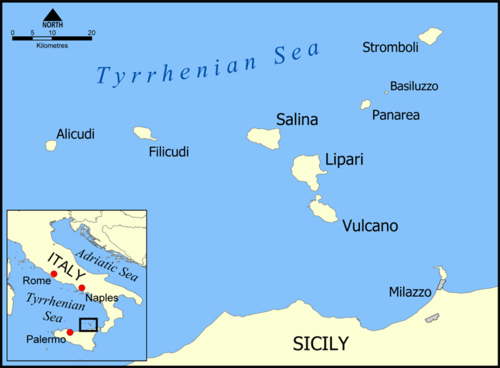
The islands colonized by the Greeks approximately 580 years before the birth of Christ, located in the Tyrrhenian Sea off the coast of Sicily, were called the Aeolian Islands, believed by the Greeks to be the home of the god of the winds, Aeolus.
There are seven significant islands: Lipari, Vulcano, Panarea, Salina, Stromboli, Filicudi, and Alicudi, and a set of minor islands and rocks…all volcanic in origin but only three still active.
In antiquity, the islands were contended by various superpowers of the era: the Etruscans, the Greeks, the Byzantines and the Romans, all fighting to maintain a position of strategic importance in the Tyrrhenian Sea.
In more recent history, and after the fall of the Roman Empire, centuries of volcanic eruptions contributed to the mass exodus of people from the islands. It wasn’t until the twelfth century that the re-population of the islands began, and not until the 1700’s did the inhabitants begin to flourish again.
The archipelago is also the backdrop of Homer’s epic poem ‘The Odyssey’.
The Odyssey is the story of Odysseus, king of Ithaca, who wanders for 10 years trying to get back home after the Trojan War. The Odyssey is an adventure-filled poem with the struggles of Odysseus to return home to his beloved Ithaca, the love of his faithful wife Penelope, and his only son Telemachus. It is the story of the endless clash between good and evil, and hard-won triumphs between the humans and the Gods. It is an enduring classic of humanity, betrayal, love and loyalty. The Odyssey is often cited by critics as being one of the greatest stories ever told.
 Floriana
Leave a comment